Sex Differences in Aggression in Real-world Settings a Meta-analytic Review Summarry
What you'll acquire to do: describe changes in cognitive development and moral reasoning during adolescence

Here we learn near adolescent cognitive development. In boyhood, changes in the encephalon collaborate with experience, knowledge, and social demands and produce rapid cognitive growth. The changes in how adolescents call back, reason, and understand can exist even more dramatic than their obvious physical changes. This stage of cerebral development, termed by Piaget as the formal operational stage, marks a movement from the power to think and reason logically only about concrete, visible events to an power to also call up logically about abstract concepts.
Adolescents are now able to analyze situations logically in terms of cause and effect and to entertain hypothetical situations and entertain what-if possibilities nearly the globe. This higher-level thinking allows them to think nigh the hereafter, evaluate alternatives, and set up personal goals. Although at that place are marked individual differences in cerebral development amidst teens, these new capacities allow adolescents to appoint in the kind of introspection and mature determination making that was previously beyond their cognitive capacity.
Learning outcomes
- Explain Piaget'southward theory on formal operational thought
- Depict cognitive abilities and changes during adolescence
- Depict the part of secondary education in adolescent development
- Describe moral development during boyhood
Cognitive Evolution during Boyhood

Figure 1. Adolescents practice their developing abstract and hypothetical thinking skills, coming up with culling interpretations of information.
Boyhood is a time of rapid cerebral development. Biological changes in brain structure and connectivity in the brain collaborate with increased experience, noesis, and changing social demands to produce rapid cognitive growth. These changes by and large begin at puberty or shortly thereafter, and some skills continue to develop as an adolescent ages. Development of executive functions, or cognitive skills that enable the control and coordination of thoughts and beliefs, are generally associated with the prefrontal cortex area of the encephalon. The thoughts, ideas, and concepts developed at this period of life greatly influence ane's future life and play a major part in character and personality formation.
Perspectives and Advancements in Adolescent Thinking
At that place are two perspectives on boyish thinking: constructivist and information-processing. The constructivist perspective , based on the work of Piaget, takes a quantitative, stage-theory approach. This view hypothesizes that adolescents' cognitive comeback is relatively sudden and drastic. The information-processing perspectivederives from the study of artificial intelligence and explains cognitive development in terms of the growth of specific components of the overall procedure of thinking.
Improvements in bones thinking abilities more often than not occur in five areas during boyhood:
- Attention. Improvements are seen in selective attention (the procedure by which ane focuses on 1 stimulus while tuning out another), every bit well as divided attention (the ability to pay attention to two or more stimuli at the same time).
- Memory. Improvements are seen in working memory and long-term memory.
- Processing Speed.Adolescents think more than quickly than children. Processing speed improves sharply between age five and center adolescence, levels off around age 15, and does not announced to modify between tardily adolescence and machismo.
- Organisation. Adolescents are more than aware of their own thought processes and tin use mnemonic devices and other strategies to think and retrieve information more efficiently.
- Metacognition. Adolescents can remember about thinking itself. This often involves monitoring i's own cognitive activity during the thinking process. Metacognition provides the ability to program ahead, see the future consequences of an activeness, and provide alternative explanations of events.
Formal Operational Idea
In the final of the Piagetian stages, a child becomes able to reason non just about tangible objects and events, simply also about hypothetical or abstruse ones. Hence it has the name formal operational stage—the period when the private can "operate" on "forms" or representations. This allows an private to retrieve and reason with a wider perspective. This stage of cognitive development, termed by Piaget as formal operational thought, marks a motility from an power to remember and reason from concrete visible events to an ability to think hypothetically and entertain what-if possibilities about the world. An individual tin solve problems through abstract concepts and utilise hypothetical and deductive reasoning. Adolescents use trial and error to solve bug, and the ability to systematically solve a problem in a logical and methodical way emerges.
Scout It
This video explains some of the cerebral development consequent with formal operational thought.
Formal Operational Thinking in the Classroom
Schoolhouse is a main contributor in guiding students towards formal operational thought. With students at this level, the teacher can pose hypothetical (or contrary-to-fact) problems: "Whatifthe world had never discovered oil?" or "Whatif the first European explorers had settled first in California instead of on the East Coast of the United states?" To answer such questions, students must utilise hypothetical reasoning, meaning that they must dispense ideas that vary in several ways at once, and exercise so entirely in their minds.
The hypothetical reasoning that concerned Piaget primarily involved scientific issues. His studies of formal operational thinking therefore often look similar bug that middle or high school teachers pose in science classes. In i problem, for instance, a young person is presented with a unproblematic pendulum, to which different amounts of weight tin be hung (Inhelder & Piaget, 1958). The experimenter asks: "What determines how fast the pendulum swings: the length of the string property it, the weight attached to it, or the distance that information technology is pulled to the side?" The young person is non immune to solve this problem by trial-and-error with the materials themselves, just must reason a mode to the solution mentally. To do then systematically, he or she must imagine varying each factor separately, while also imagining the other factors that are held constant. This kind of thinking requires facility at manipulating mental representations of the relevant objects and deportment—precisely the skill that defines formal operations.
As you lot might doubtable, students with an power to remember hypothetically accept an advantage in many kinds of schoolhouse piece of work: by definition, they crave relatively few "props" to solve problems. In this sense they can in principle be more self-directed than students who rely but on physical operations—certainly a desirable quality in the opinion of most teachers. Note, though, that formal operational thinking is desirable but notsufficient for schoolhouse success, and that information technology is far from beingness the simply way that students achieve educational success. Formal thinking skills do not insure that a student is motivated or well-behaved, for example, nor does it guarantee other desirable skills. The fourth stage in Piaget'south theory is really about a item kind of formal thinking, the kind needed to solve scientific problems and devise scientific experiments. Since many people do not normally bargain with such problems in the normal form of their lives, information technology should exist no surprise that inquiry finds that many people never achieve or utilize formal thinking fully or consistently, or that they apply it just in selected areas with which they are very familiar (Case & Okomato, 1996). For teachers, the limitations of Piaget's ideas suggest a need for boosted theories about development—ones that focus more than directly on the social and interpersonal issues of childhood and boyhood.
Hypothetical and abstract thinking
One of the major premises of formal operational thought is the capacity to think of possibility, not merely reality. Adolescents' thinking is less bound to concrete events than that of children; they can contemplate possibilities outside the realm of what currently exists. One manifestation of the adolescent's increased facility with thinking nigh possibilities is the improvement of skill indeductive reasoning (also called top-down reasoning), which leads to the development of hypothetical thinking. This provides the ability to plan ahead, see the future consequences of an activeness and to provide alternative explanations of events. It as well makes adolescents more skilled debaters, as they can reason against a friend's or parent's assumptions. Adolescents likewise develop a more sophisticated understanding of probability.
This advent of more systematic, abstruse thinking allows adolescents to comprehend the sorts of higher-society abstract logic inherent in puns, proverbs, metaphors, and analogies. Their increased facility permits them to appreciate the ways in which linguistic communication can be used to convey multiple messages, such as satire, metaphor, and sarcasm. (Children younger than age nine often cannot comprehend sarcasm at all). This also permits the awarding of advanced reasoning and logical processes to social and ideological matters such as interpersonal relationships, politics, philosophy, faith, morality, friendship, religion, fairness, and honesty.
Metacognition
Metacognition refers to "thinking nigh thinking." It is relevant in social knowledge every bit it results in increased introspection, cocky-consciousness, and intellectualization. Adolescents are much meliorate able to sympathize that people do not accept complete command over their mental action. Being able to introspect may lead to forms of egocentrism, or self-focus, in adolescence. Adolescent egocentrism is a term that David Elkind used to describe the phenomenon of adolescents' inability to distinguish between their perception of what others think well-nigh them and what people actually think in reality. Elkind's theory on adolescent egocentrism is drawn from Piaget's theory on cognitive developmental stages, which argues that formal operations enable adolescents to construct imaginary situations and abstract thinking.
Accordingly, adolescents are able to anticipate their own thoughts and excogitate of other people'south thoughts.However, Elkind pointed out that adolescents tend to focus mostly on their own perceptions, especially on their behaviors and appearance, because of the "physiological metamorphosis" they experience during this period. This leads to adolescents' conventionalities that other people are equally circumspect to their behaviors and appearance as they are of themselves.According to Elkind, adolescent egocentrism results in two distinct problems in thinking: the imaginary audience and the personal fable. These probable peak at age fifteen, along with self-consciousness in general.
Imaginary audition is a term that Elkind used to draw the miracle that an adolescent anticipates the reactions of other people to him/herself in bodily or impending social situations. Elkind argued that this kind of anticipation could exist explained by the adolescent's preoccupation that others are equally admiring or every bit critical of them as they are of themselves.As a consequence, an audience is created, as the boyish believes that they will be the focus of attention.
However, more than ofttimes than not the audience is imaginary because in bodily social situations individuals are non usually the sole focus of public attention. Elkind believed that the construction of imaginary audiences would partially business relationship for a broad diversity of typical adolescent behaviors and experiences; and imaginary audiences played a role in the self-consciousness that emerges in early boyhood. However, since the audition is usually the boyish'southward own construction, it is privy to his or her own knowledge of him/herself. Co-ordinate to Elkind, the notion of imaginary audience helps to explain why adolescents usually seek privacy and feel reluctant to reveal themselves–it is a reaction to the feeling that one is e'er on phase and constantly under the disquisitional scrutiny of others.
Elkind also addressed that adolescents accept a circuitous set of beliefs that their own feelings are unique and they are special and immortal.Personal fable is the term Elkind created to describe this notion, which is the complement of the structure of imaginary audience. Since an adolescent normally fails to differentiate their own perceptions and those of others, they tend to believe that they are of importance to and so many people (the imaginary audiences) that they come to regard their feelings every bit something special and unique. They may feel that only they take experienced potent and various emotions, and therefore others could never sympathise how they feel. This uniqueness in one's emotional experiences reinforces the adolescent's belief of invincibility, especially to death.
This boyish belief in personal uniqueness and invincibility becomes an illusion that they tin can be above some of the rules, disciplines and laws that use to other people; even consequences such as death (called the invincibility fable).This belief that one is invincible removes whatsoever impulse to control one's behavior (Lin, 2016). [1] Therefore, adolescents will engage in risky behaviors, such as drinking and driving or unprotected sex, and feel they volition not suffer whatever negative consequences.
Effort It
Intuitive and Analytic Thinking
Piaget emphasized the sequence of thought throughout 4 stages. Others suggest that thinking does not develop in sequence, but instead, that advanced logic in adolescence may be influenced by intuition. Cognitive psychologists often refer to intuitive and analytic idea as the dual-procedure model; the notion that humans have 2 distinct networks for processing information (Kuhn, 2013.) [2] Intuitive thought is automatic, unconscious, and fast, and it is more experiential and emotional.
In contrast, a nalytic thought is deliberate, conscious, and rational (logical). While these systems interact, they are distinct (Kuhn, 2013). Intuitive thought is easier, quicker, and more ordinarily used in everyday life. Equally discussed in the boyish brain development department earlier in this module, the discrepancy betwixt the maturation of the limbic arrangement and the prefrontal cortex, may brand teens more prone to emotional intuitive thinking than adults. As adolescents develop, they gain in logic/analytic thinking ability and sometimes regress, with social context, education, and experiences becoming major influences. Simply put, being "smarter" as measured by an intelligence exam does non advance knowledge as much equally having more than experience, in school and in life (Klaczynski & Felmban, 2014). [three]
Adventure-taking
Because most injuries sustained past adolescents are related to risky behavior (alcohol consumption and drug utilize, reckless or distracted driving, and unprotected sex activity), a great deal of research has been washed on the cognitive and emotional processes underlying adolescent take a chance-taking. In addressing this question, information technology is important to distinguish whether adolescents are more likely to engage in risky behaviors (prevalence), whether they make gamble-related decisions similarly or differently than adults (cognitive processing perspective), or whether they utilise the same processes but value different things and thus make it at different conclusions. The behavioral decision-making theory proposes that adolescents and adults both counterbalance the potential rewards and consequences of an activity. However, enquiry has shown that adolescents seem to give more weight to rewards, particularly social rewards, than do adults. Adolescents value social warmth and friendship, and their hormones and brains are more than attuned to those values than to long-term consequences (Crone & Dahl, 2012). [4]
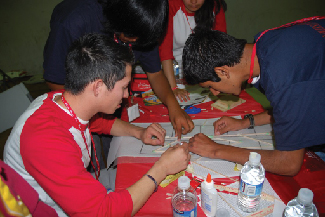
Effigy ii. Teenage thinking is characterized by the ability to reason logically and solve hypothetical problems such as how to pattern, plan, and build a structure. (credit: U.S. Army RDECOM)
Some have argued that there may be evolutionary benefits to an increased propensity for risk-taking in boyhood. For example, without a willingness to accept risks, teenagers would not have the motivation or confidence necessary to leave their family of origin. In addition, from a population perspective, there is an advantage to having a group of individuals willing to have more than risks and try new methods, counterbalancing the more conservative elements more typical of the received knowledge held by older adults.
Relativistic Thinking
Adolescents are more likely to engage in relativistic thinking—in other words, they are more likely to question others' assertions and less likely to accept information as absolute truth. Through feel outside the family circle, they larn that rules they were taught as absolute are actually relativistic. They begin to differentiate betwixt rules crafted from common sense (don't affect a hot stove) and those that are based on culturally relative standards (codes of etiquette). This can lead to a period of questioning authority in all domains.
As we continue through this module, we volition talk over how this influences moral reasoning, likewise as psychosocial and emotional development. These more abstract developmental dimensions (cognitive, moral, emotional, and social dimensions) are not merely more subtle and difficult to measure, just these developmental areas are as well difficult to tease apart from one some other due to the inter-relationships amongst them. For case, our cerebral maturity volition influence the way we sympathise a detail event or circumstance, which volition in plow influence our moral judgments about it, and our emotional responses to it. Similarly, our moral code and emotional maturity influence the quality of our social relationships with others.
School During Adolescence
Secondary Education
Adolescents spend more waking time in school than in whatsoever other context (Eccles & Roeser, 2011).Secondary instruction is traditionally grades seven-12 and denotes the school years after elementary schoolhouse (known as primary education) and before college or university (known as tertiary pedagogy). Adolescents who complete master educational activity (learning to read and write) and continue on through secondary and tertiary pedagogy tend to as well have better health, wealth, and family life (Rieff, 1998).[5] Because the boilerplate age of puberty has declined over the years, middle schools were created for grades five or six through eight as a way to distinguish between early adolescence and late boyhood, peculiarly considering these adolescents different biologically, cognitively and emotionally and definitely accept different needs.
Transition to middle schoolhouse is stressful and the transition is ofttimes complex. When students transition from simple to middle schoolhouse, many students are undergoing concrete, intellectual, social, emotional, and moral changes (Parker, 2013). [vi] Research suggests that early adolescence is an especially sensitive developmental period (McGill et al., 2012).[seven] Some students mature faster than others. Students who are developmentally backside typically experience more stress than their counterparts (U.S. Section of Education, 2008).[8] Consequently, they may earn lower grades and display decreased bookish motivation, which may increase the charge per unit of dropping out of school (U.Due south. Department of Education, 2008). For many middle schoolhouse students, academic achievement slows down and behavioral problems can increase.
Specific Middle School Issues
Regardless of a student's gender or ethnicity, heart schoolhouse is challenging. Although young adolescents seem to desire independence, they likewise need protection, security, and structure (Brighton, 2007).[nine] Baly, Cornell, & Lovegrove (2014) found that bullying increases in middle school, peculiarly in the kickoff yr.[10] Additionally, unlike elementary schoolhouse, concerns arise regarding procedural changes. Merely when egocentrism is at information technology's height, students are worried about being thrown into an environment of independence and responsibility. They are expected to get to and from classes on their own, manage fourth dimension wisely, organize and go on upward with materials for multiple classes, be responsible for all classwork and homework from multiple teachers, and at the same time develop and maintain a social life (Meece & Eccles, 2010).[eleven] Students are trying to build new friendships and maintain ones they already have. Equally noted throughout this module, peer credence is peculiarly important.
Some other attribute to consider is technology. Typically, adolescents become their first cell phone at most age xi and, simultaneously, they are also expected to inquiry items on the Internet. Social media use and texting increment dramatically and the enquiry finds both harm and benefits to this apply (Coyne et al., 2018).[12]
Teens, Engineering, and Bullying
Bullying is unwanted, ambitious behavior among schoolhouse aged children that involves a existent or perceived power imbalance. The behavior is repeated, or has the potential to be repeated, over time. Both kids who are bullied and who bully others may have serious, lasting problems. It is a prevalent problem during the middle and high schoolhouse years, exacerbated by access to applied science and the means to easily spread damaging data online. These are some key statistics about bullying from StopBullying.gov:
-
Been Bullied
-
Bullied Others
- Approximately 30% of immature people admit to bullying others in surveys.
-
Seen Bullying
- 70.half-dozen% of young people say they have seen bullying in their schools.
- 70.iv% of schoolhouse staff have seen bullying. 62% witnessed bullying two or more than times in the final month and 41% witness bullying once a calendar week or more than.
- When bystanders intervene, bullying stops within ten seconds 57% of the fourth dimension.
-

Effigy iii. Cyberbullying comes in many forms.
-
Been Cyberbullied
-
How Often Bullied
- In one large study, about 49% of children in grades four–12 reported existence bullied by other students at school at least once during the by calendar month, whereas thirty.8% reported bullying others during that time.
- Defining "frequent" involvement in bullying as occurring two or more times within the past month, 40.six% of students reported some type of frequent involvement in bullying, with 23.2% being the youth oftentimes bullied, 8.0% being the youth who ofttimes bullied others, and 9.four% playing both roles frequently.
-
Types of Bullying
- The most common types of bullying are verbal and social. Physical bullying happens less oftentimes. Cyberbullying happens the least frequently.
- According to one big study, the following percentages of middle schools students had experienced these various types of bullying: name calling (44.ii %); teasing (43.3 %); spreading rumors or lies (36.iii%); pushing or shoving (32.iv%); hitting, slapping, or kicking (29.2%); leaving out (28.v%); threatening (27.four%); stealing belongings (27.three%); sexual comments or gestures (23.7%); e-mail service or blogging (9.9%).
-
Where Bullying Occurs
- Most bullying takes place in school, exterior on schoolhouse grounds, and on the school bus. Bullying as well happens wherever kids gather in the community. And of course, cyberbullying occurs on jail cell phones and online.
- According to one large report, the following percentages of middle schools students had experienced bullying in these diverse places at schoolhouse: classroom (29.3%); hallway or lockers (29.0%); cafeteria (23.4%); gym or PE class (nineteen.5%); bathroom (12.2%); playground or recess (6.ii%).iii
Many organizations, schools, teachers, parents, and lawmakers are working to address the issue of bullying. One example is that of ReThink, a technology designed by teenager Trisha Prabhu to recognize bullying online and encourage posters to reconsider their behavior (watch Trisha Prabhu'south TED talk)
High School
Equally adolescents enter into high school, their continued cognitive development allows them to think abstractly, analytically, hypothetically, and logically, which is all formal operational thought. Loftier school emphasizes formal thinking in endeavor to ready graduates for higher where analysis is required. Overall, high school graduation rates in the Us have increased steadily over the past decade, reaching 83.ii percent in 2016 after four years in loftier schoolhouse (Gewertz, 2017).[13] Additionally, many students in the U.s. do attend college. Unfortunately, though, nigh half of those who get to college go out without a degree (Kena et al., 2016).[xiv] Those that do earn a caste, however, do make more than money and accept an easier time finding employment. The key here is understanding boyish development and supporting teens in making decisions virtually college or alternatives to college subsequently loftier school.
Link to learning
What do you think, is college necessary? Is it worth the investment? Read the commodity "Is College Necessary?" from Psychology Today geared towards parents who can help their teenager make up one's mind if higher is right for them.
Academic Achievement
Academic achievement during boyhood is predicted by interpersonal (e.k., parental engagement in adolescents' education), intrapersonal (e.chiliad., intrinsic motivation), and institutional (e.thou., school quality) factors. Academic achievement is important in its own right every bit a mark of positive adjustment during adolescence just also because bookish achievement sets the stage for future educational and occupational opportunities. The most serious consequence of school failure, particularly dropping out of school, is the high risk of unemployment or underemployment in adulthood that follows. Loftier achievement can ready the stage for college or future vocational preparation and opportunities.
Try It
Moral Reasoning During Adolescence
Moral Reasoning in Adolescence

Figure 4. Adolescents' moral development gets put to the examination in existent life situations, often along with peer pressure level to acquit or not acquit in particular ways.
As adolescents become increasingly indepenparing, they also develop more nuanced thinking almost morality, or what is right or wrong. We all make moral judgments on a daily basis. As adolescents' cognitive, emotional, and social development continue to mature, their understanding of morality expands and their behavior becomes more than closely aligned with their values and beliefs. Therefore, moral development describes the evolution of these guiding principles and is demonstrated past the power to apply these guidelines in daily life. Understanding moral development is of import in this stage where individuals make and so many important decisions and gain more than and more legal responsibility.
If you lot recall from the module on Middle Childhood, Lawrence Kohlberg (1984) argued that moral development moves through a serial of stages, and reasoning well-nigh morality becomes increasingly complex (somewhat in line with increasing cognitive skills, equally per Piaget'southward stages of cognitive development). Every bit children develop intellectually, they pass through iii stages of moral thinking: the preconventional level, the conventional level, and the postconventional level. In center childhood into early adolescence, the child begins to intendance well-nigh how situational outcomes impact others and wants to please and be accepted (conventional morality). At this developmental phase, people are able to value the good that tin can be derived from holding to social norms in the form of laws or less formalized rules. From boyhood and beyond, adolescents begin to use abstract reasoning to justify behaviors. Moral behavior is based on self-called upstanding principles that are more often than not comprehensive and universal, such equally justice, dignity, and equality, which is postconventional morality.
Influences on Moral Development
Adolescents are receptive to their civilisation, to the models they see at home, in school and in the mass media. These observations influence moral reasoning and moral behavior. When children are younger, their family, civilisation, and faith greatly influence their moral decision-making. During the early on adolescent period, peers have a much greater influence. Peer pressure tin exert a powerful influence because friends play a more significant part in teens' lives. Furthermore, the new ability to retrieve abstractly enables youth to recognize that rules are merely created by other people. As a effect, teens begin to question the absolute authorisation of parents, schools, regime, and other traditional institutions (Vera-Estay, Dooley, & Beauchamp, 2014) [fifteen] By late adolescence, about teens are less rebellious as they have begun to establish their ain identity, their ain conventionalities system, and their own identify in the world.
Unfortunately, some adolescents have life experiences that may interfere with their moral development. Traumatic experiences may cause them to view the world equally unjust and unfair. Additionally, social learning too impacts moral development. Adolescents may have observed the adults in their lives making immoral decisions that disregarded the rights and welfare of others, leading these youth to develop beliefs and values that are contrary to the rest of social club. That being said, adults have opportunities to support moral evolution past modeling the moral character that we desire to see in our children. Parents are specially important considering they are more often than not the original source of moral guidance. Administrative parenting facilitates children'south moral growth improve than other parenting styles and one of the most influential things a parent can exercise is to encourage the right kind of peer relations. [16] While parents may find this procedure of moral development difficult or challenging, it is important to remember that this developmental step is essential to their children's well-being and ultimate success in life.
Link To Learning
Parenting has the largest touch on on adolescent moral development. Read more than hither in this article, "Building Grapheme: Moral Development in Adolescence" from the Center for Parent and Teen Communication.
Try It
glossary
- adolescent egocentrism:
- a feature of adolescent thinking that leads young people (ages x-13) to focus on themselves to the exclusion of others (according to David Elkind)
- analytic idea:
- thought that results from analysis, such equally a systematic ranking of pros and cons, risks and consequences, possibilities and facts. Analytic thought depends on logic and rationality
- behavioral controlling theory:
- proposes that adolescents and adults both counterbalance the potential rewards and consequences of an action. Yet, research has shown that adolescents seem to give more than weight to rewards, particularly social rewards, than do adults
- constructivist perspective:
- based on the work of Piaget, a quantitative, stage-theory arroyo. This view hypothesizes that adolescents' cognitive improvement is relatively sudden and drastic, as adolescents larn past interim on their environment and they actively construct knowledge
- deductive reasoning:
- reasoning from a general statement, premise, or principle, though logical steps to effigy out (deduce) specifics. Also chosen meridian-down processing
- divided attending:
- the power to pay attention to ii or more stimuli at the same time; this power improves during boyhood
- dual process model/dual processing:
- the notion that two networks be within the human being brain, ane for emotional processing of stimuli and one for analytic reasoning
- formal operational thought:
- the quaternary and final phase of Piaget's theory of cerebral development, characterized past more systematic logical thinking and past the ability to understand and systematically manipulate abstract concepts
- hypothetical thought:
- reasoning that includes propositions and possibilities that may not reflect reality
- imaginary audience:
- the other people who, in an adolescent'south egocentric belief, are watching and taking notation of his or her advent, ideas, and beliefs. This conventionalities makes many adolescents very self-conscious
- information-processing perspective:
- derives from the study of artificial intelligence and explains cerebral development in terms of the growth of specific components of the overall process of thinking
- intuitive thought:
- thoughts that ascend from an emotion or a hunch, beyond rational explanation, and are influenced by past experiences and cultural assumptions
- invincibility legend:
- an boyish'southward egocentric confidence that he or she cannot exist overcome or fifty-fifty harmed by anything that might defeat a normal mortal, such equally unprotected sex, drug corruption, or loftier-speed driving
- metacognition:
- refers to "thinking virtually thinking" and it is relevant in social knowledge and results in increased introspection, self-consciousness, and intellectualization during adolescence
- middle school:
- a school for children in the grades betwixt elementary school and loftier school. Middle school commonly begins with grade vi and ends with grade 8
- mnemonic devices:
- mental strategies to help larn and recollect information more efficiently; improves during adolescence
- personal fable:
- an aspect of adolescent egocentrism characterized by an adolescent's belief that his or her thoughts, feelings, and experiences are unique, more wonderful, or more awful than anyone else's
- relativistic thinking:
- thinking that understands the relative or situational nature of circumstances
- secondary education:
- the period later chief instruction (elementary or course school) and before tertiary instruction (higher). Information technology usually occurs from most ages 12 to 18, although there is some variation past schoolhouse and by nation
- selective attending:
- the process by which ane focuses on one stimulus while tuning out another; this ability improves during adolescence
Source: https://courses.lumenlearning.com/wmopen-lifespandevelopment/chapter/cognitive-development-in-adolescence/

Post a Comment for "Sex Differences in Aggression in Real-world Settings a Meta-analytic Review Summarry"